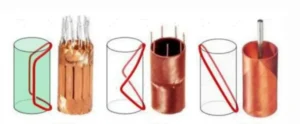
An automated winding and forming solution for high-current figure-eight-shaped coils made from large-cross-section flat or round wire.
1. Machine Overview
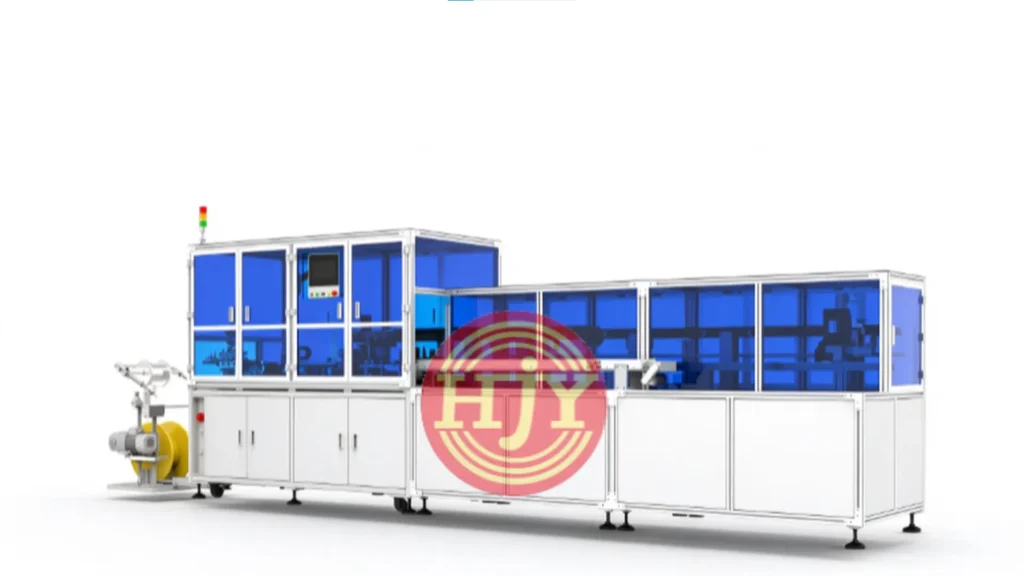
The JHY fully automatic figure-eight coil winding machine is developed for the high-efficiency production of figure-eight-shaped coils made from large-cross-section flat or round wire.
The machine integrates precision wire feeding, programmable winding motion, tension control and coil forming into an automated production process. It reduces manual handling and helps maintain stable coil geometry, winding position and finished dimensions throughout batch production.
Different winding paths, wire specifications and coil dimensions can be configured through customised tooling and programmable process parameters. This allows the machine to support multiple figure-eight coil models as well as other customised coil geometries.
Designed for 24/7 continuous production, the machine offers high output, stable operation and reduced dependence on manual labour. It is suitable for manufacturers planning automated, repeatable and scalable coil production.
2. What Is a Figure-Eight-Shaped Coil?
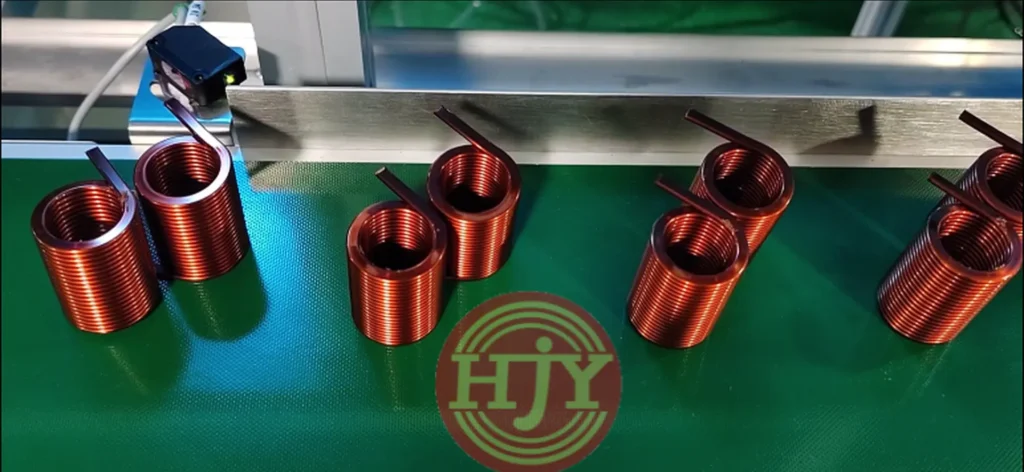
A figure-eight-shaped coil uses a winding path consisting of two connected loop sections. Depending on the product design, the wire may cross or transition at the centre to create the required electrical and structural configuration.
Compared with conventional circular or rectangular coils, figure-eight coils require more complex control of the wire path, bending position and forming sequence. The challenge increases when large-cross-section flat wire is used because the wire has higher bending resistance and its orientation must remain controlled throughout the winding process.
The winding method must therefore be developed according to the wire dimensions, bending direction, number of turns, crossover position, coil dimensions and allowable forming tolerance.
3.Key Manufacturing Challenges
3.1 Controlling Flat-Wire Orientation
Flat wire must remain correctly oriented throughout feeding, winding and forming. Uncontrolled rotation or twisting may affect coil dimensions, insulation quality and the position of adjacent turns.
The wire-guiding and winding mechanisms must work together to control the wide and narrow surfaces of the flat wire during every stage of the winding cycle.
3.2 Bending Large-Cross-Section Wire
Large-cross-section wire requires greater forming force than conventional fine wire. The equipment must control the bending position and bending radius while reducing the risk of insulation damage, excessive springback or unwanted deformation.
3.3 Maintaining a Stable Winding Path
The two loop sections and the centre transition must be formed according to the programmed winding path. Accurate motion control is required to maintain coil symmetry, prevent wire displacement and keep the finished dimensions within the required tolerance.
3.4 Tension Control
Stable wire tension helps control conductor positioning and coil consistency. Excessive tension may stretch the wire or damage the insulation, while insufficient tension may result in loose turns and unstable forming.
The tension parameters should be matched to the wire material, cross-sectional dimensions, winding speed and coil geometry.
3.5 Dimensional Consistency
Important process-control items may include:
- Overall coil length and width
- Dimensions of the two loop sections
- Centre crossover or transition position
- Coil thickness and height
- Number of turns
- Wire spacing and alignment
- Lead-wire position and length
- Insulation condition
- Electrical resistance
4. Key Machine Features
Bilingual Touchscreen Control
The integrated Chinese and English touchscreen interface provides clear operating guidance and convenient parameter adjustment. Operators can manage winding settings, production recipes, alarms and equipment status through the HMI.
The programmable winding mechanism controls wire movement and coil forming according to the defined product path. This helps improve the consistency of coil shape, conductor position and finished dimensions.
Stable Tension Control
The tension-control system can be configured according to the wire type and winding process. Stable tension helps reduce loose winding, wire displacement and dimensional variation.
Flat and Round Wire Compatibility
The machine can be customised for both flat and round wire. Wire-guiding components, tooling and forming mechanisms are selected according to the wire dimensions, material properties and product structure.
Flexible Product Changeover
Multiple product recipes can be stored in the control system. Product changeover can be completed by replacing the corresponding tooling and selecting the required process parameters.
The actual compatible product range and changeover time depend on the differences between the coil models.
Durable Machine Construction
Key mechanical components use wear-resistant materials and suitable surface-treatment processes to support stable operation under continuous production conditions.
Safety and Alarm Functions
The equipment can be configured with safety guarding, emergency stops, fault alarms and process-parameter memory. These functions help reduce operating risks and simplify troubleshooting and production recovery.
5. Supported Products and Wire Types
The machine can be developed for different wire and product specifications based on the customer’s drawings and production requirements.
- Rectangular or flat enamelled wire
- Round enamelled wire
- Large-cross-section conductor applications
- Figure-eight-shaped coils in different dimensions
- Single-turn and multi-turn coil structures
- High-current inductive coils
- Customised coil shapes and winding paths
- Multiple product models produced on one machine
Final compatibility must be evaluated according to the wire dimensions, conductor material, insulation type, number of turns, bending radius, finished-coil dimensions and required production cycle.
6. Automated Production Process
The machine can integrate the main operations required for figure-eight coil production into a programmable automated process.
Typical Production Sequence
Wire Feeding → Wire Positioning → Figure-Eight Winding → Coil Forming → Wire Cutting → Finished-Coil Unloading
Depending on the product and automation requirements, the machine can also be connected to automatic loading, visual inspection, electrical testing, material handling and downstream assembly equipment.
Standardised communication interfaces allow the equipment to exchange production status, alarm and process information with an automated line or factory management system.
7. Benefits of Automated Figure-Eight Coil Winding
- Reduced manual winding and forming operations
- Improved coil-shape and dimensional consistency
- Stable wire orientation and winding tension
- Reduced dependence on operator experience
- Higher production capacity
- Repeatable process parameters
- Flexible production of multiple coil models
- Easier integration with upstream and downstream automation
- Production data and alarm traceability
The appropriate level of automation should be determined according to the product structure, annual production volume, target cycle time, changeover frequency and required inspection processes.
8. Typical Applications
- New energy vehicle power components
- Onboard chargers
- DC-DC converters
- Photovoltaic inverters
- Energy storage power conversion systems
- High-current inductive components
- Power electronics equipment
- Industrial electrical systems
- Customised electromagnetic components
9. JHY Customised Automation Solutions
JHY provides customised equipment and automation solutions for figure-eight-shaped coils made from large-cross-section flat or round wire.
Our engineering support covers winding-process development, equipment design, tooling, coil forming, automatic loading and unloading, inspection and production-line integration. Solutions can be configured for prototype development, small-batch trial production or automated mass production.
For customers with multiple coil models, JHY can evaluate product compatibility, tooling changeover and recipe management to determine whether the products can be manufactured on one machine.
Information Required for Project Evaluation
To evaluate the winding process and equipment configuration, please provide:
- Product and coil drawings
- Flat- or round-wire specifications
- Conductor and insulation materials
- Number of turns
- Detailed winding path
- Starting- and finishing-wire positions
- Finished-coil dimensions and tolerances
- Product samples, if available
- Target cycle time
- Annual production volume
- Automatic loading, unloading and inspection requirements
Discuss Your Figure-Eight Coil Winding Project
If you are planning to automate the production of figure-eight-shaped coils made from large-cross-section flat or round wire, contact JHY. Our engineering team can evaluate your product and develop a suitable winding process, customised machine or complete automated production solution.
You are also welcome to visit the JHY factory to review our winding technology, equipment capabilities and customised automation solutions.